

If you’re a 50+ fitness enthusiast or a trainer that works with the boomers, consider incorporating these 3 principles into your workouts to help you remain active and injury free.
1. It’s All About the Core! The importance of having a strong stable core can’t be emphasized enough – it helps with balance, posture and quality movement. When engaging in exercises activate the core first, then move out from this stable center. This is key if you’re using hand weights or resistance bands, otherwise you’re at greater risk for injury.
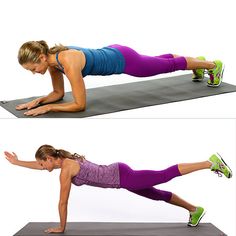 Pilates is one of the best methods for developing core strength as it focuses on both your flexors and extensors. So often the back side of our body is ignored with the focus on abdominal strength. This just creates more imbalance between our Flexors (front side) and Extensors (back side) resulting in a forward leaning, rounded posture. This is already the direction we’re headed as we age, so strengthening our backs, glutes and hamstrings is important to counteract this. Stretching our hip flexors, pecs and shoulders is too, but we’ll cover that later.
New to Pilates? Try a mat class to ease into the principles and you’ll soon find out just how effective Pilates is in strengthening your entire core. The Plank is a great exercise that works your core all the way around. You can start on your elbows, work up to planks on your hands and then to alternating arm and leg lifts.
2. Develop Your Balance. It’s easy incorporate balance training into your exercises and even throughout your day. Good balance will keep you dancing and light on your feet, ultimately reducing your risks of falls and broken bones. You can develop your static balance by adjusting your stance during your workouts. The traditional stance is with feet about hip width apart. Start with feet wide then narrow stance until feet touch together. From there you can stagger your stance, stand toe to heel and progress to standing on one foot. Adding arm movements, resistance bands or light weights while in these alternate stances will challenge your balance even more. Keep your core engaged and focus your eyes on a steady target to enhance stability when doing this progression and in balancing poses in yoga. First try the activities above with good supportive shoes on then progress to doing static balance postures barefoot.
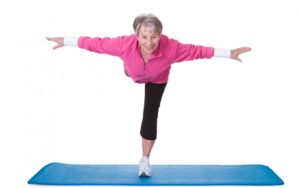 Dynamic balance is developed through movement, so for example instead of standing toe to heel, move forward as if walking a tight rope, then move backwards doing the same. Moving forward, back and side to side on your tiptoes then on heels with toes pulled up will develop dynamic balance. Try a dance class for multi-directional movement and quick on your feet movement changes. Balance disks and rockers boards shift your center of gravity and require quick postural adjustments – but start standing inside doorway and hold onto door frame with both hands!
3. Stretch Yourself! Our muscles and tendons gradually lose elasticity as we age. Combine that with years of long commutes, sitting at a desk job or the accumulated hours spent with head down and body in a forward flexed posture. The result is shortened tight muscles like the pecs, hip flexors and hamstrings, which effect an upright posture, flexibility and ease of movement.
You can prevent muscle and tendon injuries before working out by gradually warming up the muscles with easy movements, then gently stretching before starting a vigorous workout, tennis game or day of skiing. However, if you want to improve your overall flexibility incorporate a good long stretch session at the end of your workout when your muscles are all warmed up and already stretched out a bit. This will also help you ward off the post workout stiffness. Key areas to stretch are the calves / heel cords, hamstrings, quads, hip flexors, glutes, low back, trunk rotators, side body, pecs, shoulders and neck. So basically, a good head to toe stretch for 10 to 20 minutes after a workout will give you a great return! Your posture will improve, aches, pains and stiffness will decrease and you’ll be less prone to muscle strains and ligament sprains during your fitness for seniors. If you experience wrist pain while working out, order our workout gloves with wrist support to make life a little easier.
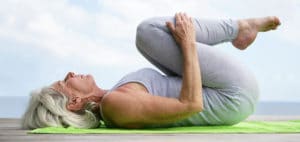 Adding a few yoga classes per week into your fitness routine will only accelerate these gains. Of the many styles of yoga Yin, Hatha, Inyengar are 3 that have a slower pace. For example in Yin yoga the poses are held for a longer duration to provide a deeper stretch to the muscles and fascia. If you stick with your yoga exercises for older adults you’ll find the benefits go well beyond improved flexibility.

I find that using a roller with my Pilates sessions has been a great way for my clients to lengthen at the same time strenghen their core and structural muscles. It releases the facia so their muscles can move more at ease.
Penny- Thanks so much for your input. I personally use 2 different types of rollers and find it very beneficial for my low back, IT band, mid-back, shoulders and calves. I have not however used a roller in my Pilates workouts and would love to learn more. Can you give me an example of a Pilates exercise that you use the roller with and where the roller is placed? Thanks again for reading out newsletter and your comments.
-Paula
Thanks for your articles about wrists and proper stretching ..I ordered your wrist brace with padding and they were too large ( med.). Can I switch them for a small at this time?
Thanks , Arlene
Arlene- We’re happy to exchange your WAGs for you. Please reach out to our customer service at 800-606-4577 x1 or info@getwags.com and Heather will take care of you. Thanks for your feedback on the articles we post and send to our customers. We appreciate it! Do let us know if there are any topics you’d like more information on. -Paula
I just ordered my second pair of wags because I completely wore out my first pair. I love them! Since I have been using them, my wrist and thumb pain have diminished to the point that I don’t think about it often at all. I do not recommend them for yoga because the padding is not comfortable in down dog poses, but I used them for everything else that I do and highly recommend them if you have chronic wrist and thumb pain.
Thanks for your feedback Judy. We’re so glad to hear that WAGs have enabled you to exercise without wrist and thumb pain bothering you.
We’ll send you some tips for proper positioning and weight distribution in downward dog position so you can try WAGs again for yoga.
I’ve used the Pro and Ultra styles for yoga for years, but now find the WAGs Fusion to be my favorite.
Thanks again Judy for your comments!
I love my WAGS. They have really helped to cushion my arthritic thumbs. How do you recommend washing them? Is it okay to throw them in the washer?