
Hey! Have you ever wondered whether a pair of gloves could do what a wrist brace does?
Well, it’s a fair question, especially when you’re looking at therapeutic gloves for wrist pain and trying to figure out whether they’re actually worth it. Both offer support, but not in the same way.
While a brace is designed to support or restrict wrist movement, gel-padded gloves focus on cushioning the palm and making certain movements more comfortable. So, which one makes more sense if you have arthritis, tendinitis, or wrist discomfort during exercise? To find the answer you have to figure out what’s causing the pain and what you’ll need to support.
Why Do Wrists Hurt When We Put Weight On Them?
Hands are built for mobility, not for carrying body weight. The wrist is a cluster of small bones held together by ligaments and tendons, with the median nerve passing through the carpal tunnel. Unlike your heel, there’s no large bone with a fat pad underneath.
When you lean on a flat palm, the wrist extends close to its limit, and the soft tissues take the load. Repeat that dozens of times in a class, or hold it for a minute, and tendons, ligaments and joints complain. That’s true whether the cause is tendinitis, arthritis at the base of the thumb, weak wrists or an old sprain that never fully healed.

What is the Difference Between Gel-Padded Gloves and Wrist Braces?
The difference becomes easier to understand when you look at what each product is designed to do.
Gel-padded gloves: These feature a cushioned pad, often shaped to follow the natural contours of the palm. Depending on their design, they can help reduce concentrated pressure when your hands support your body weight or grip equipment. Some also include adjustable wrist wraps for additional support.
Wrist braces: These typically use straps, rigid inserts, or supportive materials to limit certain wrist movements. They may be recommended when an injured or irritated joint or tendon needs temporary stabilization.
How Do Therapeutic Gloves For Wrist Pain Actually Work?
A good pair doesn’t hold your wrist still the way a rigid splint does. It changes the geometry. Wrist Assured Gloves (WAGs) use a patented, contoured, wedge-shaped gel pad that reduces wrist extension by 15 degrees, spreads pressure across the palm, and is thicker at the heel of the hand to cushion the carpal bones. A V-shaped cut-out keeps pressure off the median nerve where it crosses the wrist.
You can see the anatomy behind that design on our glove ergonomics page.
Some styles also add an adjustable elastic wrap for soft support and stability without locking the joint.
To be straightforward: no glove has been proven to cure arthritis or tendinitis, and fitness gloves aren’t a medical treatment. What they can do is take strain off movements you might otherwise avoid.
Gel-Padded Gloves vs. a Wrist Brace: How Do You Choose?
That difference is the whole decision. Use this as a starting point:
| Your situation | Usually the better fit |
| Pain during push-ups, planks, yoga, lifting, or cycling | Gel-padded gloves like Wrist Assured Gloves (WAGs) |
| Pain flares after repetitive use, but you want to stay active | Gel-padded glove, with ice and rest between sessions |
| Fresh sprain, suspected fracture, or recent surgery | Brace or splint, as directed by your clinician |
| Numbness or tingling, especially at night | See a clinician first; a neutral-position night splint is usually recommended. Then WAGs when exercising will keep pressure off the median nerve. |
| Constant ache even at rest | Get it assessed before choosing either |
It doesn’t have to be either-or. A clinician might suggest a splint for sleep while you use a glove for daytime activity.
If floor exercises tend to trigger your wrist pain, also check out our guide to wrist support gloves for push-ups, planks, and yoga.
Can Gloves For Arthritic Hands And Tendinitis Really Help?
Yes, well-designed therapeutic gloves can make certain activities more comfortable by cushioning the palm, redistributing pressure, and providing extra support.
For people exploring therapeutic gloves for arthritic hands, comfort is often just as important as support. Arthritis can cause joint pain, stiffness, tenderness, and difficulty gripping everyday objects. WAG’s wrist support gloves provide a comfortable layer around the hand, while the gel-padded design helps reduce pressure beneath the palm and thumb during weight-bearing activities.
Gloves for tendinitis work on the same principle: less wrist angle and less pressure during the repetitive movement that irritates the tendon. They don’t replace relative rest or gradual strengthening, and sharp pain is still a signal to stop.
Which WAGs Style Should You Try First?
All four styles share a contoured gel pad that lifts the heel of your hand. They differ in pad thickness and in whether there’s an adjustable wrap.
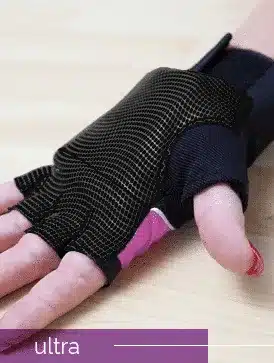
- Ultra: the most support. A thick wedged pad plus an adjustable elastic wrap with a finger loop for easy tightening. It’s great for arthritis, tendonitis, thumb joint pain, ligament injury, and joint laxity, but not for carpal tunnel syndrome or chronic swelling, because of the elastic wrist wrap compression.
- Pro: the same pad, no wrist wrap. Ultra’s ergonomic benefit without the wrap. It’s the style suggested for mild carpal tunnel syndrome, and it also works well for arthritis, tendonitis, and thumb joint pain.
- Fusion: soft leather with a wrap. Flex’s slimmer pad with a wrist wrap, in soft leather with extra padding at the palm, knuckles, and thumb. If you’ve wondered whether a leather glove with a gel pad and wrap suits a weak or unstable wrist, this is that glove. The same cautions with the wrist wrap apply.
- Flex: the lightest touch. A shorter, slimmer pad gives more palm contact and easier grasping, so it suits weightlifting and cycling, mild wrist pain, thumb discomfort, and prevention.
So, Gloves Or A Brace? Start With Your Trigger
A brace is for rest; a glove is for moving more comfortably. If your pain appears when you bear weight or grip, a glove is a sensible, low-risk place to start.
It matters beyond comfort, too. Weight-bearing exercise helps maintain bone density, and avoiding it because of wrist pain means missing that stimulation, which becomes more important with age.
Wrist Assured Gloves (WAGs) come with a 30-day money-back guarantee, so you can test the fit on your own routine. Your next step: match your symptoms to the WAGs style page, and run it past your clinician if any warning sign above sounds familiar.
FAQs
What are therapeutic gloves for wrist pain, and who should use them?
They use a gel pad or padding to reduce wrist extension and spread pressure during activity. They suit adults with sore wrists, arthritis, or tendinitis who want to keep moving and bearing weight on the hands.
What gloves help with wrist pain from arthritis or tendinitis?
Look for a contoured gel pad that lowers wrist extension. The Ultra style adds a wrist wrap and a thick pad; Pro keeps the same pad without a wrap, which suits swelling or wrap-sensitivity.
Are leather gloves with a gel pad and wrist wrap good for weak or injured wrists?
They can be, once an injury is diagnosed and cleared for activity. The Fusion style pairs soft leather, a slimmer pad, and a wrap, but isn’t recommended for carpal tunnel syndrome or chronic swelling.
Are gel-padded gloves better than regular padded gym gloves?
For wrist strain, often yes. Regular gym gloves cushion grip and calluses but don’t change wrist angle. A wedge-shaped pad reduces extension, which is what loads a sore wrist.
Do wrist support gloves really help with wrist injuries?
They can ease strain during activity, but they aren’t treatment. Injuries still need rest, a proper diagnosis, and sometimes rehab. Think of them as support while you recover.